Beethoven's Early Piano Sonatas

During the Baroque period, sonatas were generally composed for more than one instrument, but towards the middle of the 18th century, several Italian composers, such as Domenico Scarlatti and Domenico Alberti, began writing them for solo keyboard. This practice became common later in the century: there are numerous keyboard sonatas by Carl Philipp Emanuel Bach, Joseph Haydn, Wolfgang Amadeus Mozart, and others, written shortly before or during Beethoven’s early life. By the 1780s sonatas had become established as the leading form of keyboard music—designed for harpsichord, clavichord, or the rapidly evolving pianoforte—and Beethoven quickly took up the genre.
Beethoven’s first three sonatas were composed and published in 1783, when he was only 12 years old, but they are full-scale, three-movement works, and the third is actually longer than his famous “Moonlight” Sonata of 1801. Known as his “Electoral” Sonatas (dedicated to his patron the Elector of Cologne), they are often disregarded since they have no opus number (WoO [“Works without opus number”] 47 in the catalogue), but they are excellent compositions, and show considerable imagination and compositional technique. In each case, as was normal, the first movement is essentially in sonata form, and is followed by a slow movement and lively finale. They can be played on harpsichord or clavichord, but they work best on the pianoforte—either a modern one or a period instrument—like all his subsequent sonatas. As was common with groups of three works, two are in major keys and one is in a minor key, the latter (No. 2) particularly notable as it has a slow introduction that reappears later in the first movement—an idea found in several of Beethoven’s later works, including his Pathétique Sonata of 1798–99.

Beethoven completed no more piano sonatas while living in his native Bonn, but after moving to Vienna, in November 1792, he began preparing another set of three. These were not completed until 1795, however, and finally appeared as Op. 2 in March 1796. Once again, one is in a minor key and the other two are in major keys, but the most notable feature is that each has four movements, with a minuet between the slow movement and finale, rather than the usual three (or possibly only two, as in earlier sonatas). Beethoven seems to have been angling towards the symphony, which typically has four movements, and his intensive development of certain motives (short musical ideas) in the three sonatas is more characteristic of symphonies than of sonatas, which typically tended to have greater motivic variety. Although the first one begins with a standard rising arpeggio (sometimes called a “Mannheim rocket,” since the pattern had been much used by Mannheim composers), there is much originality in each of the three sonatas, as well as formidable technical demands in Nos. 2 and 3. No. 3 is unusual in having a slow movement in the remote key of E major after a first movement in C major, but the connection is made plain halfway through the movement, when the theme suddenly reappears in C major, drawing attention not just to the original key but to the similarity between the themes of the two movements. This kind of sophistication, coupled with the technical demands and depth of expression, helped to raise this set of sonatas above those of Beethoven’s contemporaries, and they were widely reprinted in the next few years.
 The main theme from the second movement in E major appears in C major (to the right of "ff"), from the first edition of Beethoven's Op. 2 No. 3 (Vienna: Artaria, 1796).
Beethoven’s next published sonata was his Grand Sonata in E-flat, Op. 7 (1796–97). A “grand sonata” was a specific subgenre—intended to challenge composer, pianist, and audience alike—and Op. 7 certainly fulfils that aim. Again it is in four movements, but built on an unusually large scale. Listeners of the period might have thought that the exposition of the first movement had almost finished, only to realize it was less than halfway through. The slow movement is intensely profound, and the remaining two movements are also on a larger scale than usual.
Around the time Beethoven was composing this sonata he also composed two short two-movement sonatas, probably for a specific commission. He evidently did not intend to publish them, but they eventually appeared as Op. 49 in 1805, apparently through pressure from his brother Carl. They were described as “sonates faciles” (“easy sonatas”)—another subgenre, the opposite of the “grand sonata.” He had also begun another set of three sonatas, which appeared as Op. 10 in 1798. Again the first is in a minor key and the other two are in major keys, but the first two have only three movements while the third is on a larger scale and has an extra minuet before the finale. No. 1, again, begins with a rising arpeggio, but in a jagged shape with a dotted rhythm (short note–long note), and this figure reappears in the second part of the slow movement, heightening the sense of overall unity. The finale is in sonata form, but very compact. As usual, there is a high level of invention and originality, and Beethoven always makes sharp contrasts between his opening gestures: here, the jagged opening of the first sonata contrasts with two solid chords at the start of No. 2 and a passage in octaves at the start of No. 3.
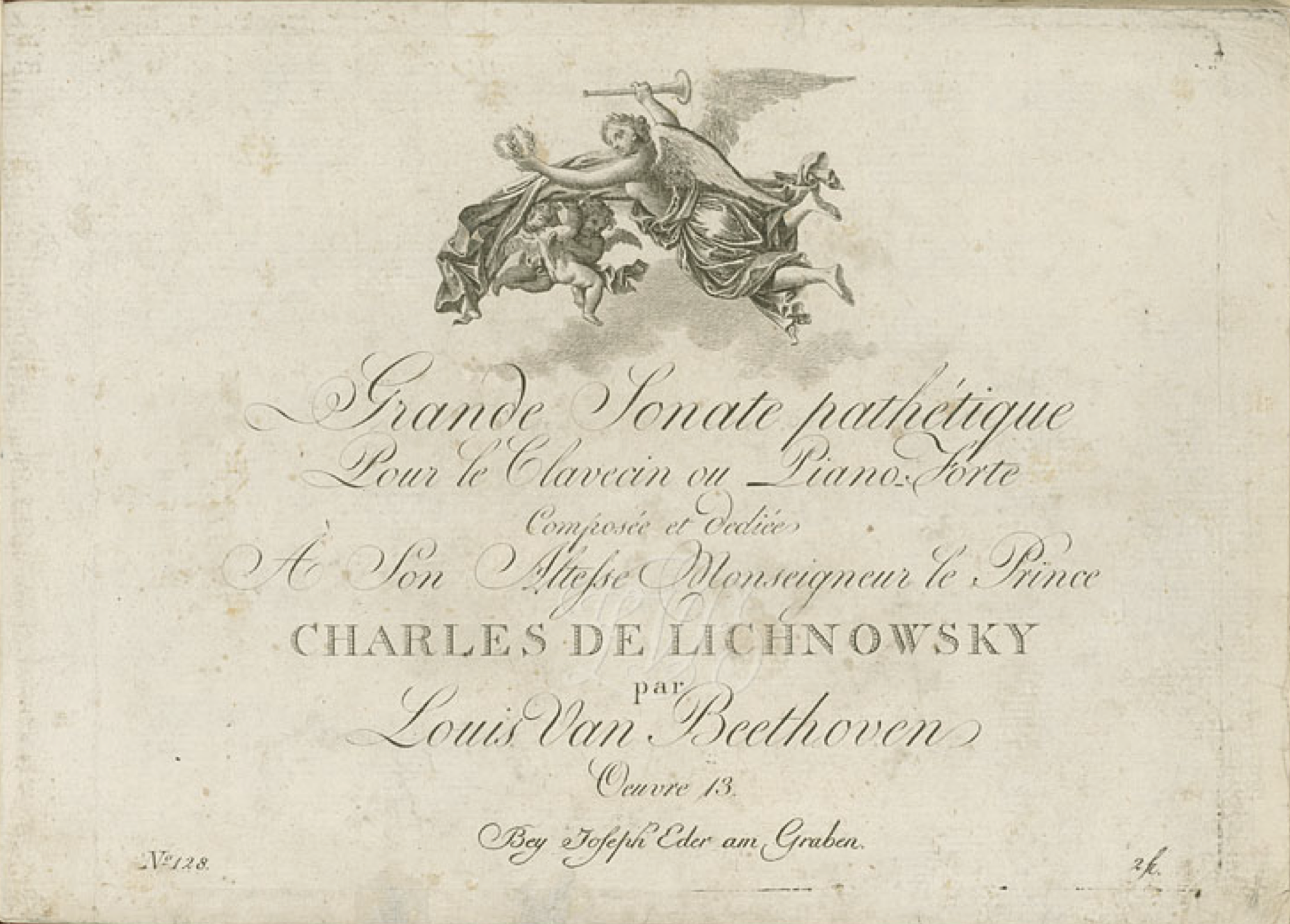 Reprint of the first edition of Beethoven's Sonata No. 8 in C minor for Piano, Op. 13 (Vienna: Joseph Eder, 1800).
His next sonatas may also have been planned initially as a group of three, but the first was so striking that it was published separately as Op. 13, its two successors as Op. 14. Op. 13 is the famous Grande sonate pathétique in C minor, in which the slow introduction and three main movements are all designed to evoke a sense of pathos—with sudden silences, anguished discords, yet intense lyricism, especially in the lovely slow movement. There are subtle melodic connections between the movements: the theme of the finale incorporates motives derived from the previous two movements, and, just before the end, it hints once more at the sound of the slow movement in A-flat major. The two sonatas of Op. 14 are much lighter and more cheerful: No. 1 has something of the character and texture of a string quartet (Beethoven was actually persuaded to arrange it for string quartet a few years later); No. 2 contains many humorous touches, with a sudden loud chord at the end of the slow movement and a jokey finale theme full of cross-rhythms that make the meter hard to follow at first.
All three sonatas were published in 1799, and Beethoven brought the century to a close with another “grand sonata,” completed in 1800 and published the following year as Op. 22 in B-flat. He evidently considered this to be a particularly excellent piece of work, and it seems to do everything expected of a grand sonata: a regular first movement in sonata form, an elegant slow movement in 9/8 meter, a graceful minuet, and a tuneful finale in rondo form (contrasting episodes in the middle). Beethoven was now poised to become more experimental in his sonatas of the new century.
________
Article by Barry Cooper