Beethoven: The Piano Virtuoso

When Ludwig van Beethoven was 12 years old, his new teacher, Christian Neefe, wrote an article about the music scene in Beethoven's hometown of Bonn and observed that this boy, if he kept going as he had, could be the next Wolfgang Amadeus Mozart. By that point Mozart, at 27, had been famous for some two decades. Then, and later, there would be many predictions about “the next Mozart”; Beethoven was the only one that panned out. But he followed a path quite different from his predecessor’s, and much of that had to do with his relation to the piano.
Beethoven began in music as a harpsichordist, but by age ten was entirely a pianist—which is to say that he was among the first generation to grow up as a pianist, rather than changing over from harpsichord to piano in midcareer, as Mozart did. The piano was fundamentally embedded in Beethoven's musical consciousness. From early on, he was concerned with how to play and compose for it. Of course, the fortepianos of Beethoven's day were hardly more robust than harpsichords, and had a restricted range. But they possessed the all-important quality that gave them their name: unlike the harpsichord, they could play gradations of volume, from forte (loud) to piano (soft). And that was what the Classical style, with its rich contrasts, demanded.
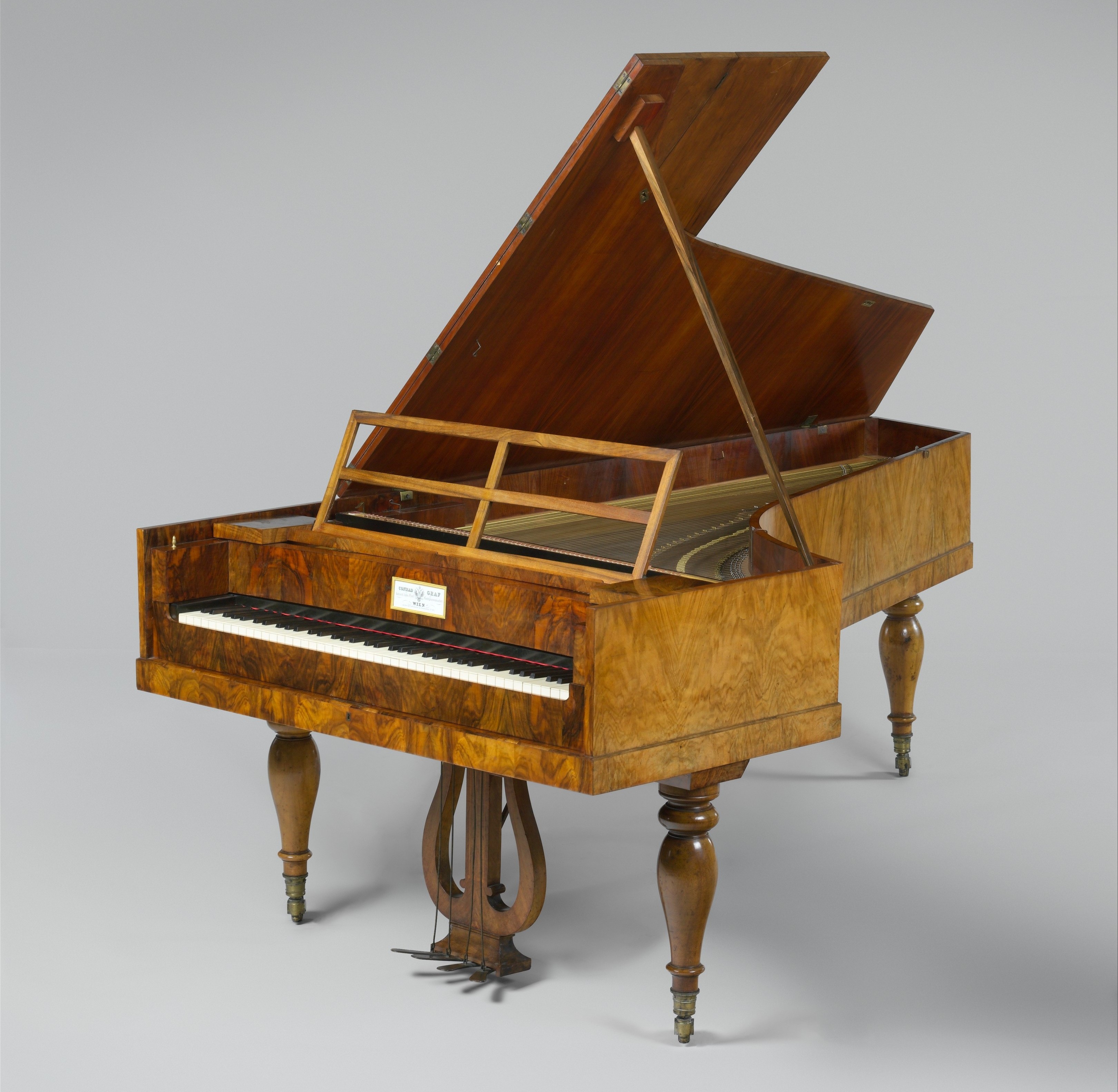 Fortepiano made by Conrad Graf in Vienna, ca. 1838 ( from The Metropolitan Museum of Art).
Another difference between Beethoven and Mozart was a matter of focus in their teens. By age ten, Mozart was already a seasoned virtuoso, but his main concern was composing. He had been a prolific composer since he was six, and by 16 or so was creating lasting work. Beethoven, in his teens, concentrated on the keyboard. (He recalled practicing “prodigiously,” often well into the night.) By the time Beethoven was 20, an admiring critic noted that he had a keyboard technique “entirely his own.” Meanwhile, his teenage composing was more sporadic than Mozart's, and not all that ambitious—more promising than polished. In his maturity, Beethoven would be noted for the unprecedented depth of notational detail in his piano music, beyond anything seen before. In fact, in his first piano sonatas, from around age 12, he reveled in keyboard effects of volume and touch well beyond his later music—often beyond what the instrument could actually manage, such as sudden changes of volume and touch within fast passages.
By the time Beethoven came to Vienna, in 1792, he was already a formidable pianist, and soon established himself among the leading virtuosos in Europe. He was especially noted for his dazzling improvisations that could leave audiences breathless and tearful. His student Carl Czerny said that when it came to finished works, Beethoven’s most profound playing was in slow movements. His technique seems to have been quite modern: observers said his fingers seemed to rest on the keys with minimal movement. (Most of this performing was in private salons; piano sonatas were virtually never played in public.)
Meanwhile, improvising at the keyboard was his primary creative engine, ideas flowing directly from his imagination to his fingers. And the boldness of his published work, with its wild contrasts and unprecedented drama, came from improvisation wedded to rigorous logic and control of form. The evidence is in his first published pieces, all of them centered around his instrument: the three piano trios of Op. 1, the three piano sonatas of Op. 2, the two cello sonatas of Op. 5 (for cello and piano).
Beethoven: Trio in C minor for Piano, Violin, and Cello, Op. 1, No. 3
Beethoven's childhood mentor Neefe was more an organist and harpsichord player—not much involved with the piano. But Neefe did do one thing for his student that was, in a way, epochal: he gave the boy J.S. Bach’s The Well-Tempered Clavier (or WTC, 1722/1742). Beethoven learned most that wellspring of Western music. In its indefatigable variety, the WTC is a profound exploration not just of what the harpsichord can do, but of what music itself can do. At that point, it was something of a cult item known mainly to connoisseurs. Beethoven made some of his early reputation in Vienna playing its preludes and fugues. Perhaps from that experience, he acquired what may or may not have been a conscious goal but was nevertheless the result: he wrote the first ambitious body of true piano sonatas—in their scope and variety, the equivalent of the WTC.
Behind that ambition lay a conviction about Mozart as a player and Haydn and Mozart as composers. He told friends that, during a teenage visit to Vienna, he heard Mozart play piano and wasn’t impressed. No legato, he complained. He felt that, as composers, Haydn and Mozart were really stuck in a harpsichord vein. This wasn’t entirely fair, especially considering Haydn's late piano music, but that’s what he thought. When it came to the piano, Beethoven believed that he was the first composer to understand its full potential.
This explains some peculiarities of his first period as a composer, when he was polishing his craft and mastering one medium and genre after another. It’s notable that his first string quartets, Op. 18 (1799), are fine works, but not particularly bold, not “Beethovenian” to our ears—they are audibly in Haydn's orbit. Yet the earlier Pathétique piano sonata (Op. 13, 1798), in its passion and dynamism, is as Beethovenian as it gets. The explanation is that with quartets, Beethoven knew he was on Haydn’s turf: the older man had invented the modern conception of the medium, and Beethoven was not ready to challenge him. But when it came to piano music, Beethoven considered that his turf. He owned it, so he was bolder sooner.
Beethoven: Quartet in C minor for Strings, Op. 18 No. 4
Part of that boldness was his relentless struggle against the limitations of the instrument. In a period when the piano was evolving rapidly, Beethoven was steadily in contact with piano makers, each of them with their own secrets, their own style within a broader tradition of national styles: British and French pianos more robust, Viennese more delicate. To the Viennese makers Beethoven cried give me more range, more volume! and they listened. As soon as new notes appeared on the keyboard, he used them. The first full flowering of his sonatas came after he acquired a French Érard, which was more powerful than Viennese instruments. Soon came historic works exploring new dimensions of the piano: the “Waldstein” (Op. 53, 1803–04), the “Appassionata” (Op. 57, 1804–06). His 32 mature piano sonatas amount to one of the broadest and deepest creative journeys in all music.
In all his pieces in any given genre, Beethoven was determined never to repeat himself. (For example, the gentle Sixth Symphony followed the raging Fifth.) This ideal is perhaps most striking in the piano sonatas: in each of them he did not just come up with new musical ideas, but essentially remade the instrument, from the murmuring mystery of the “Moonlight” (Op. 27 No. 2, 1802) to the flashing colors of the “Appassionata” to the sublime late sonatas, with their vast range of sonorities. So when he took up a new sonata, he was looking not just for themes and structures, but for a coloration and texture unique to that piece, all of it founded on the innate nature of the instrument.
Even after encroaching deafness wrecked his career as a virtuoso, Beethoven never left the piano. He still spent hours improvising at the keyboard, hearing the notes only in his mind. In many ways all his music rose from the piano and his relation to it. To the end, he never gave that up.
________
Article by Jan Swafford